|
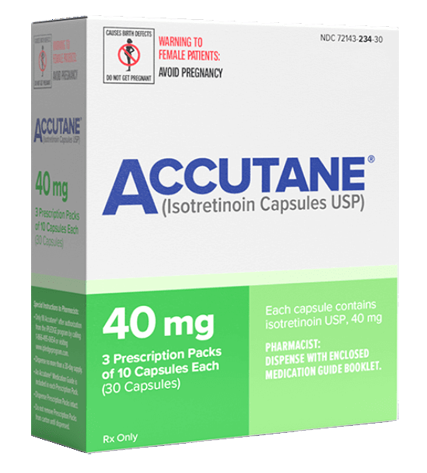
Isotretinoin (Generic Accutane) is used
to treat severe cystic acne (also known
as nodular acne) that has not responded
to other treatment (e.g., benzoyl peroxide
or clindamycin applied to the skin or
tetracycline or minocycline taken by mouth).
Isotretinoin belongs to a class of drugs known as
retinoids. It works by decreasing facial
oil (sebum) production. High amounts of
sebum can lead to severe acne. If left
untreated, severe acne may cause permanent
scarring.
|
| |
| Availability:
In Stock |
Brand vs Generic |
|
Manufacturer: TBA
|
 |
| Sold Under Brand
Name: Accutane |
|
| Average Delivery Time: 12 Days |
|
| Prescription Required:No |
Shipping Only $12.75 |
 |
Quantity |
Strength |
Price (USD) |
|
| 30 Cap(s) |
20mg Isotretinoin |
$59.00 |
 |
| 60 Cap(s) |
20mg Isotretinoin |
$109.00 |
 |
| 90 Cap(s) |
20mg Isotretinoin |
$157.00 |
 |
| 120
Cap(s) |
20mg Isotretinoin |
$180.00 |
 |
| 240
Cap(s) |
20mg
Isotretinoin |
$275.00 |
 |
|
GENERIC NAME: Isotretinoin
BRAND NAME: Accutane
IMPORTANT WARNING:
For all patients:
Isotretinoin must not be taken by patients
who are pregnant or who may become pregnant.
There is a high risk that Isotretinoin will
cause loss of the pregnancy, or will cause the
baby to be born too early, to die shortly after
birth, or to be born with birth defects (physical
problems that are present at birth).
A program called iPLEDGE has been set up to
make sure that pregnant women do not take Isotretinoin
and that women do not become pregnant while
taking Isotretinoin. All patients, including
women who cannot become pregnant and men, can
get Isotretinoin only if they are registered
with iPLEDGE, have a prescription from a doctor
who is registered with iPLEDGE and fill the
prescription at a pharmacy that is registered
with iPLEDGE. Do not buy Isotretinoin over the
internet.
You will receive information about the risks
of taking Isotretinoin and must sign an informed
consent sheet stating that you understand this
information before you can receive the medication.
You will need to see your doctor every month
during your treatment to talk about your condition
and the side effects you are experiencing. At
each visit, your doctor may give you a prescription
for up to a 30 day supply of medication with
no refills. You must have this prescription
filled within 7 days. If you do not have your
prescription filled within 7 days and you are
a woman who can become pregnant, you will not
be able to get Isotretinoin until it is time
for your next office visit, 23 days after the
7 days have passed. If you are a man or if you
are a woman who cannot become pregnant, you
will need to visit your doctor again to talk
about the safe use of Isotretinoin and to get
a new prescription. You may have the new prescription
filled right away.
Tell your doctor if you do not understand everything
you were told about Isotretinoin and the iPLEDGE
program or if you do not think you will be able
to keep appointments or fill your prescription
on schedule every month.
Your doctor will give you an identification
number and card when you start your treatment.
You will need this number to fill your prescriptions
and to get information from the iPLEDGE website
and phone line. Keep the card in a safe place
where it will not get lost. If you do lose your
card, you can ask for a replacement through
the website or phone line.
Do not donate blood while you are taking Isotretinoin
and for 1 month after your treatment.
Do not share Isotretinoin with anyone else,
even someone who has the same symptoms that
you have.
Your doctor or pharmacist will give you the
manufacturer's patient information sheet (Medication
Guide) when you begin treatment with Isotretinoin
and each time you refill your prescription.
Read the information carefully and ask your
doctor or pharmacist if you have any questions.
You can also visit the Food and Drug Administration
(FDA) website (http://www.fda.gov/cder), the
manufacturer's website, or the iPLEDGE program
website (http://www.ipledgeprogram.com) to obtain
the Medication Guide.
Talk to your doctor about the risks of taking
Isotretinoin.
For female patients:
If you can become pregnant, you will need to
meet certain requirements during your treatment
with Isotretinoin. You need to meet these requirements
even if you have not started menstruating (having
monthly periods) or have had a tubal ligation
('tubes tied'; surgery to prevent pregnancy).
You may be excused from meeting these requirements
only if you have not menstruated for 12 months
in a row and your doctor says you have passed
menopause (change of life) or you have had surgery
to remove your uterus and/or both ovaries. If
none of these are true for you, then you must
meet the requirements below.
You must use two acceptable forms of birth
control for 1 month before you begin to take
Isotretinoin, during your treatment, and for
1 month after your treatment. Your doctor will
tell you which forms of birth control are acceptable,
and will give you written information about
birth control. You can also have a free visit
with a doctor or family planning expert to talk
about birth control that is right for you. You
must use these two forms of birth control at
all times unless you can promise that you will
not have any sexual contact with a male for
1 month before your treatment, during your treatment,
and for 1 month after your treatment.
If you choose to take Isotretinoin, it is your
responsibility to avoid pregnancy for 1 month
before, during, and for 1 month after your treatment.
You must understand that any form of birth control
can fail. Therefore, it is very important to
decrease the risk of accidental pregnancy by
using two forms of birth control. Tell your
doctor if you do not understand everything you
were told about birth control or you do not
think that you will be able to use two forms
of birth control at all times.
If you plan to use oral contraceptives (birth
control pills) while taking Isotretinoin, tell
your doctor the name of the pill you will use.
Isotretinoin interferes with the action of microdosed
progestin ('minipill') oral contraceptives (Ovrette,
Micronor, Nor-QD). Do not use this type of birth
control while taking Isotretinoin.
If you plan to use hormonal contraceptives
(birth control pills, patches, implants, injections,
rings, or intrauterine devices), be sure to
tell your doctor about all the medications,
vitamins, and herbal supplements you are taking.
Many medications interfere with the action of
hormonal contraceptives. Do not take St. John's
wort if you are using any type of hormonal contraceptive.
You must have two negative pregnancy tests
before you can begin to take Isotretinoin. Your
doctor will tell you when and where to have
these tests. You will also need to be tested
for pregnancy in a laboratory each month during
your treatment, when you take your last dose,
and 30 days after you take your last dose.
You will need to contact the iPLEDGE system
by phone or the internet every month to confirm
the two forms of birth control you are using
and to answer two questions about the iPLEDGE
program. You will only be able to continue to
get Isotretinoin if you have done this, if you
have visited your doctor to talk about how you
are feeling and how you are using your birth
control and if you have had a negative pregnancy
test within the past 7 days.
Stop taking Isotretinoin and call your doctor
right away if you think you are pregnant, you
miss a menstrual period, or you have sex without
using two forms of birth control. If you become
pregnant during your treatment or within 30
days after your treatment, your doctor will
contact the iPLEDGE program, the manufacturer
of Isotretinoin, and the Food and Drug Administration
(FDA). You will also talk with a doctor who
specializes in problems during pregnancy who
can help you make choices that are best for
you and your baby. Information about your health
and your baby's health will be used to help
doctors learn more about the effects of Isotretinoin
on unborn babies.
For male patients:
A very small amount of Isotretinoin will probably
be present in your semen when you take prescribed
doses of Isotretinoin. It is not known if
this small amount of Isotretinoin may harm the
fetus if your partner is or becomes pregnant.
Tell your doctor if your partner is pregnant,
plans to become pregnant, or becomes pregnant
during your treatment with Isotretinoin.
Why is Isotretinoin prescribed?
Isotretinoin is used to treat severe recalcitrant
nodular acne (a certain type of severe acne)
that has not been helped by other treatments,
such as antibiotics. Isotretinoin is in a class
of medications called retinoids. It works by
slowing the production of certain natural substances
that can cause pimples to form.
How should Isotretinoin be used?
Isotretinoin comes as a capsule to take by mouth.
Isotretinoin is usually taken twice a day with
meals. Follow the directions on your prescription
label carefully, and ask your doctor or pharmacist
to explain any part you do not understand. Take
Isotretinoin exactly as directed. Do not take
more or less of it or take it more often than
prescribed by your doctor.
Swallow the capsules whole with a full glass
of liquid. Do not chew or suck on the capsules.
Your doctor will probably start you on an average
dose of Isotretinoin and increase or decrease
your dose depending on how well you respond
to the medication and the side effects you experience.
Follow these directions carefully and ask your
doctor or pharmacist if you are not sure how
much Isotretinoin you should take.
It may take several weeks or longer for you
to feel the full benefit of Isotretinoin. Your
acne may get worse during the beginning of your
treatment with Isotretinoin. This is normal
and does not mean that the medication is not
working.
Other uses for Isotretinoin
Isotretinoin has been used to treat certain
other skin conditions and some types of cancer.
Talk to your doctor about the possible risks
of using Isotretinoin for your condition.
Isotretinoin may be prescribed for other
uses. Ask your doctor or pharmacist for more
information.
What special precautions should I follow?
Before taking Isotretinoin,
tell your doctor and pharmacist if you are
allergic to Isotretinoin, any other medications,
parabens (a preservative), or any of the ingredients
in Isotretinoin capsules. Ask your pharmacist
or check the Medication Guide for a list of
the inactive ingredients.
tell your doctor and pharmacist what prescription
and nonprescription medications, vitamins, herbal
products, and nutritional supplements you are
taking or plan to take. Be sure to mention medications
for seizures such as phenytoin (Dilantin); oral
steroids such as dexamethasone (Decadron, Dexone),
methylprednisolone (Medrol), and prednisone
(Deltasone); tetracycline antibiotics such as
demeclocycline (Declomycin), doxycycline (Monodox,
Vibramycin, others), minocycline (Minocin, Vectrin),
oxytetracycline (Terramycin), and tetracycline
(Sumycin, Tetrex, others); and vitamin A supplements.
Your doctor may need to change the doses of
your medications or monitor you carefully for
side effects.
tell your doctor if you or anyone in your family
has thought about or attempted suicide and if
you or anyone in your family has or has ever
had depression, mental illness, diabetes, asthma,
osteoporosis (a condition in which the bones
are fragile and break easily) or other conditions
that cause weak bones, a high triglyceride (fats
in the blood) level, anorexia nervosa (an eating
disorder in which very little is eaten), or
heart or liver disease.
do not breastfeed while you are taking Isotretinoin
and for 1 month after you stop taking Isotretinoin.
plan to avoid unnecessary or prolonged exposure
to sunlight and to wear protective clothing,
sunglasses, and sunscreen. Isotretinoin may
make your skin sensitive to sunlight.
you should know that Isotretinoin may cause
changes in your thoughts, behavior, or mental
health. Some patients who took Isotretinoin
have developed depression or psychosis (loss
of contact with reality), have become violent,
have thought about killing or hurting themselves,
and have tried or succeeded in doing so. You
or your family should call your doctor right
away if you experience any of the following
symptoms: anxiety,sadness, crying spells, loss
of interest in activities you used to enjoy,
poor performance at school or work, sleeping
more than usual, difficulty falling asleep or
staying asleep, irritability, anger, aggression,
changes in appetite or weight, difficulty concentrating,
withdrawing from friends or family, lack of
energy, feelings of worthlessness or guilt,
thinking about killing or hurting yourself,
acting on dangerous thoughts, or hallucinations
(seeing or hearing things that do not exist).
Be sure that your family members know which
symptoms are serious so that they can call the
doctor if you are unable to seek treatment on
your own.
you should know that Isotretinoin may cause
your eyes to feel dry and make wearing contact
lenses uncomfortable during and after your treatment.
you should know that Isotretinoin may limit
your ability to see in the dark. This problem
may begin suddenly at any time during your treatment
and may continue after your treatment is stopped.
Be very careful when you drive or operate machinery
at night.
plan to avoid hair removal by waxing, laser
skin treatments, and dermabrasion (surgical
smoothing of the skin) while you are taking
Isotretinoin and for 6 months after your treatment.
Isotretinoin increases the risk that you will
develop scars from these treatments. Ask your
doctor when you can safely undergo these treatments.
talk to your doctor before you participate in
hard physical activity such as sports. Isotretinoin
may cause the bones to weaken or thicken abnormally
and may increase the risk of certain bone injuries
in people who perform some types of physical
activity. If you break a bone during your treatment,
be sure to tell all your health care providers
that you are taking Isotretinoin.
What special dietary instructions should
I follow?
Unless your doctor tells you otherwise, continue
your normal diet.
What should I do if I forget a dose?
Skip the missed dose and continue your regular
dosing schedule. Do not take a double dose to
make up for a missed one.
What side effects can Isotretinoin cause?
Isotretinoin may cause side effects. Tell your
doctor if any of these symptoms are severe or
do not go away:
red, cracked, and sore lips
dry skin, eyes, mouth, or nose
nosebleeds
changes in skin color
peeling skin, especially on the palms and soles
changes in the nails
slowed healing of cuts or sores
bleeding or swollen gums
hair loss or unwanted hair growth
sweating
flushing
voice changes
tiredness
cold symptoms
Some side effects can be serious. If you experience
any of the following symptoms or those listed
in the IMPORTANT WARNING section, call your
doctor immediately:
headache
blurred vision
dizziness
upset stomach
vomiting
seizures
slow or difficult speech
weakness or numbness of one part or side of
the body
stomach pain
chest pain
difficulty swallowing or pain when swallowing
new or worsening heartburn
diarrhea
rectal bleeding
yellowing of the skin or eyes
dark colored urine
back, bone, joint or muscle pain
muscle weakness
difficulty hearing
ringing in the ears
vision problems
painful or constant dryness of the eyes
unusual thirst
frequent urination
trouble breathing
fainting
fast or pounding heartbeat
fever
rash
red patches or bruises on the legs
swelling of the eyes, face, lips, tongue, throat,
arms, hands, feet, ankles, or lower legs
Isotretinoin may cause the bones to stop growing
too soon in teenagers. Talk to your child's
doctor about the risks of giving Isotretinoin
to your child.
Isotretinoin may cause other side effects.
Call your doctor if you have any unusual problems
while taking Isotretinoin.
If you experience a serious side effect, you
or your doctor may send a report to the Food
and Drug Administration's (FDA) MedWatch Adverse
Event Reporting program online [at http://www.fda.gov/MedWatch/index.html]
or by phone [1-800-332-1088].
What storage conditions are needed for Isotretinoin?
Keep Isotretinoin in the container it came
in, tightly closed, and out of reach of children.
Store Isotretinoin at room temperature and away from excess
heat and moisture (not in the bathroom). Throw
away any medication that is outdated or no longer
needed. Talk to your pharmacist about the proper
disposal of your medication.
In case of emergency/overdose
In case of overdose, call your local poison
control center at 1-800-222-1222. If the victim
has collapsed or is not breathing, call local
emergency services at 911.
Symptoms of overdose may include:
vomiting
flushing
severe chapped lips
stomach pain
headache
dizziness
loss of coordination
Anyone who has taken an overdose of Isotretinoin
should know about the risk of birth defects
caused by Isotretinoin and should not donate
blood for 1 month after the overdose. Pregnant
woman should talk to their doctors about the
risks of continuing the pregnancy after the
overdose. Women who can become pregnant should
use two forms of birth control for 1 month after
the overdose. Men whose partners are or may
become pregnant should use condoms or avoid
sexual contact with that partner for 1 month
after the overdose because Isotretinoin may
be present in the semen.
What other information should I know?
Keep all appointments with your doctor and the
laboratory. Your doctor will order certain lab
tests to check your response to Isotretinoin.
It is important for you to keep a written list
of all of the prescription and nonprescription
(over-the-counter) medicines you are taking,
as well as any products such as vitamins, minerals,
or other dietary supplements. You should bring
this list with you each time you visit a doctor
or if you are admitted to a hospital. It is
also important information to carry with you
in case of emergencies.
Brand names
Accutane
Amnesteem
Claravis
Sotret
|